A Heritage of Trust
Commonwealth Trust Company was established.

Delaware enacted legislation providing that a new perpetuities period would begin on the exercise of a power of appointment; a precursor to the repeal of the Rule Against Perpetuities.
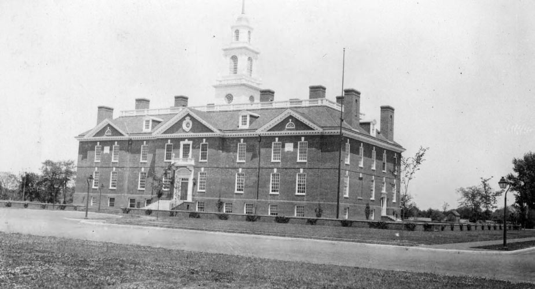
Commonwealth Trust Company and Hamilton Trust Company merged, with Commonwealth Trust Company as the surviving corporation.

Lewis v. Hanson, 128 A.2d 819 (Del. 1957), aff’d sub nom. Hanson v. Denckla, 357 US 235 (1958) established that Delaware law would be applied to the administration of all matters involving a Delaware trust and trustee.
Delaware enacted legislation (30 Del. C. § 1636) creating a state income tax deduction for trust income accumulated in irrevocable trusts for future distribution to non-Delaware resident beneficiaries.
Delaware enacted the country’s first directed trust statute (12 Del. C. § 3313), creating a statutory framework for the bifurcation of trustee duties.
Peter Horty and James (Jim) Horty, Jr. purchased a partial interest in Commonwealth Trust Company from Benjamin (Bud) Vinton.
Commonwealth Trust Company moved its offices to 29 Bancroft Mills Rd., the former Bancroft Mills, which closed in 1961. Today, the complex stands as a reminder of the significant milling history of the Brandywine Valley.

Peter and Jim Horty purchased the balance of shares of Commonwealth Trust Company stock.
Delaware enacted legislation to abolish the Rule Against Perpetuities (25 Del. C. § 503), allowing for the establishment of dynasty trusts.
The Qualified Dispositions in Trust Act (12 Del C. § 3570 et seq.) was enacted, making Delaware the second state to introduce asset protection legislation in the United States.
Delaware enacted the first total return unitrust statute in the United States (12 Del. C. § 61-106), allowing trustees to convert income trusts into total return unitrusts without court approval.
The IRS issued the first of several private letter rulings recognizing the effectiveness of incomplete-gift non-grantor trusts (also known as DING trusts in Delaware).
McNeil v. Bennett, 792 A. 2d 190 (Del. Ch. 2001) aff’d in part, rev’d in part sub nom. McNeil v. McNeil, 798 A.2d 503 (Del. 2002) became the common law foundation for the duty under Delaware law to inform individuals of the existence of trusts under which they have a beneficial interest.
Delaware enacted a decanting statute (12 Del. C. § 3528), permitting the trustee of a trust to invade the trust principal and appoint the assets in further trust for the beneficiaries of the first trust.
Duemler v. Wilmington Trust Co., C.A. No. 20033-VCS (Del. Ch. Oct. 28, 2004) upheld the liability protection afforded a directed trustee when acting at the direction of a third-party investment adviser.
Delaware enacted legislation permitting settlors to restrict the interests of beneficiaries, including the right to be informed of their interest in a trust, for a period of time by incorporating appropriate language into the trust document.
Section 548(e) of the U.S. Bankruptcy Code was amended to address asset protection trusts, expressly permitting the use of domestic asset protection trusts in non-abusive circumstances (i.e. non-fraudulent transfers).
Delaware enacted legislation expressly allowing for the creating of purpose trusts (12 Del. C. § 3556).
Delaware enacted its Principal and Income Act (12 Del. C. § 61-301 et seq).
Delaware enacted legislation to expressly state that tenancy by the entireties property contributed to a Delaware trust shall retain its character as tenancy by the entireties property (12 Del. C. § 3334).
Investment decisions are now expanded to include the determination of value as to non-traditional assets (12 Del. C. §3313(d)).
The Delaware Supreme Court issued opinions on three cases collectively referred to as the Peierls cases, IMO: Peierls Family Inter Vivos Trusts, No. 16812 (Del. Oct. 4, 2013); IMO: Ethel F. Peierls Charitable Lead Trust, No. 16811 (Del. Oct. 4, 2013); and IMO: Peierls Family Testamentary Trusts, No. 16810 (Del. Oct. 4, 2013). Together, the cases clarify that Delaware law will be deemed to govern the administration of a trust which has migrated to Delaware so long as (1) the provision relating to the appointment of a successor trustee is without geographic limitation (2) a Delaware trustee is appointed and administering the trust and (3) the choice of law provision in the trust document does not expressly provide that another jurisdiction’s laws shall always govern regardless of the actual location of the trust’s administration.
Delaware enacted a non-judicial settlement agreement statute (12 Del. C. § 3338) allowing interested parties to enter into a binding non-judicial settlement agreement with respect to any matter involving the trust, as long as it does not violate a material purpose of the trust.
Delaware enacted the Fiduciary Access to Digital Assets Statute (12 Del. C. §§ 5001-5007), one of the first state-enacted legislations in the country that allows fiduciaries to obtain the same property rights in digital assets and accounts as are regularly applied to more traditional assets.
Delaware enhanced its silent trust statute (12 Del. C. § 3303), providing a non-exclusive list of circumstances that would be deemed to constitute a “period of time” for which a beneficiary’s rights to information about his or her interest in a trust may be varied. Delaware also created the position of Designated Representative (12 Del. C. § 3339) who can bind a beneficiary during a silent period as to both judicial proceedings and non-judicial matters.
The new statute also adds a new section to Title 12 of the Delaware Code, Section 3339, which (i) includes a definition of a “designated representative,” (ii) clarifies the fact that the terms of a trust instrument may authorize certain persons to designate or appoint one or more designated representatives, (iii) provides that a person who is appointed as a designated representative will serve only upon his or her acceptance of the position, and (iv) provides a presumption that a designated representative will act in a fiduciary capacity.
Delaware enacted a trust modification statute (12 Del. C. § 3342) allowing for the modification of an irrevocable trust during the lifetime of the trust settlor and without the involvement of the courts, even if the modification violates a material purpose of the trust. The statute requires the written consent or non-objection of all settlors, all then-serving fiduciaries and all trust beneficiaries, as long as the trust is administered in Delaware.
Delaware enacted an excluded trustee statute (12 Del. C. §3313A) relating to the duties and liability of a trustee (defined in the statute as an “excluded trustee”) in cases where the trust instrument grants a different co-trustee the exclusive authority to take specified actions on behalf of the trust.`
Delaware also enacted legislation to enhance its decanting statute (12 Del. C. § 3528), now permitting a trustee to effect a trust decanting into the same trust, without needing to create a new separate trust.
The University of Delaware introduced its Minor in Trust Administration, established through a partnership between the University of Delaware and the Delaware Financial Education Alliance, intended to develop a talent pipeline of trust professionals for the future growth of the industry.
Delaware enacted a statute to allow for the allocation of trustee duties among multiple trustees (12 Del. C. § 3343), providing that a holder of the power to appoint a successor trustee also has the power to appoint multiple successor trustees and allocate trustee powers (such as the power over distribution decisions, investment decisions, or tax filings) amongst them.
Delaware also enacted a statute to address the reimbursement of income tax to the settlor of a grantor trust (12 Del. C. § 3344), allowing the trustee in its sole discretion or at the direction (or with the consent) of an adviser to reimburse the trustor for any personal income tax liability paid due to the inclusion of the trust’s income and capital gains in the trustor’s personally reportable taxable income.
Delaware enacted a statute (12 Del. C. § 3550) to allow for trust agreements and other trust documents to be executed electronically in accordance with the Uniform Electronic Transactions Act.
Remote online notarization became legal in Delaware under the Revised Uniform Law on Notarial Acts.
Delaware enacted one of the first Letter of Wishes statutes (12 Del. C. § 3301 and § 3315) defining a letter of wishes and providing guidance regarding a fiduciary’s consideration of a letter of wishes in its exercise of discretion.
Delaware also enacted the country’s first Beneficiary Well-Being Trust statute (12 Del. C. § 3345) expressly allowing for the creation of a beneficiary well-being trust to provide beneficiaries with well-being programs and allowing the trustee to access the trust to support financial education and training for beneficiaries of the trust.
Substantial majority ownership of Commonwealth Trust Company was transitioned to Caroline Horty Dickerson and James (Jimmy) Horty, III.